Blameless postmortem template with rewrite examples
An outage ends when the graphs go green. The learning starts with the postmortem. Done well, it turns a bad night into fixes that stop the same failure from coming back. Done badly, it becomes a document about who messed up, and people quietly stop reporting near misses.
This post gives you a blameless postmortem template you can copy, an example of a filled in timeline and a set of blaming sentences rewritten into neutral cause and fix statements.
What blameless actually means
Blameless doesn't mean nobody is accountable. It means the review looks at systems, tools and decisions instead of character. The assumption is that everyone acted reasonably with the information they had at the time. If a smart person made a mistake, the question is what made that mistake easy to make.
That framing gets you better data. Engineers tell the full story when they're not defending themselves.
The template
Paste this into a fresh doc and complete it within a few days of the incident, while memories are fresh.
# Postmortem: <short incident name>

**Date of incident:** 2026-10-14
**Authors:** <names>
**Status:** Draft | In review | Final
**Severity:** SEV1 | SEV2 | SEV3

## Summary
Two or three sentences. What broke, who was affected, how long it lasted.

## Impact
- Users affected:
- Duration:
- Data loss or corruption:
- Support tickets or customer reports:

## Timeline (all times UTC)
| Time  | Event |
|-------|-------|
| 14:02 | ... |

## Root cause and contributing factors
What failed, and what conditions let it fail.

## Detection
How we found out, and how long that took.

## Response and recovery
What we tried, what worked, what didn't.

## What went well
## Where we got lucky

## Action items
| Action | Owner | Due | Ticket |
|--------|-------|-----|--------|

## Lessons
The "where we got lucky" section is the one teams skip and shouldn't. It surfaces the next incident before it happens.
A sample timeline
Timelines should be facts with timestamps. No opinions, no adjectives.
| Time  | Event |
|-------|-------|
| 14:02 | Deploy 4817 rolls out config change to cache TTL |
| 14:09 | p95 latency on /checkout rises from 300ms to 4s |
| 14:15 | On-call paged by latency alert |
| 14:21 | On-call starts rollback of deploy 4817 |
| 14:34 | Rollback complete, latency back to baseline |
| 14:50 | Incident closed, follow-up channel opened |
Notice that the timeline doesn't say "unfortunately" or "mistakenly." It just says what happened and when.
Blaming sentences, rewritten
These are lines from real drafts, lightly changed. Each one is followed by a neutral version.
Blaming. "Dev pushed a bad config without testing it."
Neutral. "A config change shipped without a staging run. Our deploy pipeline doesn't require staging for config only changes."
Blaming. "On-call was slow to respond."
Neutral. "The first page went to a phone on silent mode. The pager had no escalation rule for an unacknowledged alert, so the second page came 13 minutes later."
Blaming. "The DBA should have known the migration would lock the table."
Neutral. "The migration took a full table lock. Our migration review checklist doesn't ask about lock behavior, and the tool gave no warning."
Blaming. "Support didn't escalate the customer reports fast enough."
Neutral. "Customer reports arrived in the general queue for 25 minutes before anyone linked them to the outage. There's no tag that routes outage-like tickets to the incident channel."
Each rewrite moves the subject from a person to a system and ends with something you can fix. That's the pattern to aim for every time.
Writing action items that get done
Action items fail when they're vague or have no owner.
Vague. "Improve monitoring."
Specific. "Add an alert when cache hit rate drops below 80 percent for 5 minutes. Owner Priya. Due Nov 15."
Vague. "Be more careful with config changes."
Specific. "Require a staging deploy for config only changes in the pipeline. Owner Marco. Due Nov 22."
A good test is whether a teammate who wasn't in the incident could finish the item from the ticket alone.
Running the review meeting
- Share the draft a day ahead. People read better than they listen.
- Have someone who wasn't on call facilitate. They ask the obvious questions.
- Walk the timeline first. Agree on facts before you discuss causes.
- Ask "what made this make sense at the time?" It keeps the room curious instead of defensive.
- End with owners and dates. If an action has no owner when the meeting ends, it won't get done.
Getting the tone right
Even with good intentions, incident writing drifts toward blame when people are tired and frustrated. Read your draft as the person most involved in the incident would read it. If a line would make them wince, rewrite it around the system. This guide on how to adjust the tone of a draft has more on making wording neutral without hiding what went wrong.
A paragraph that still reads like an accusation can go into Rephrase AI on the Professional profile for a calmer first phrasing, while you keep every timestamp, metric and owner name untouched.
Publish the final version where the whole team can find it. The best postmortems get read again before the next big change.
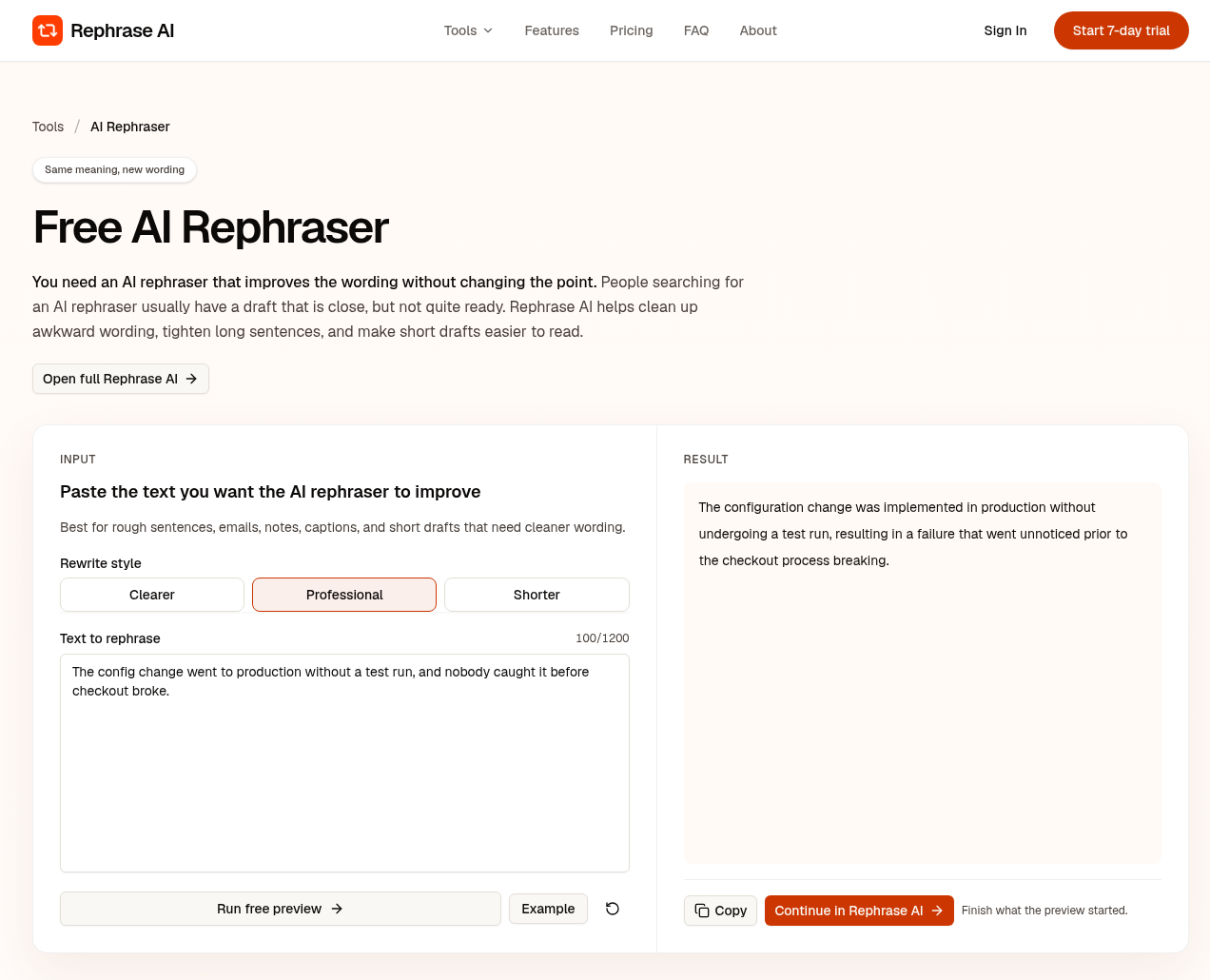
Rephrasing a blunt incident line in Rephrase AI on Professional.
About the author
- Rephrase what you wrote into what you meant to say.
Comments
Join the discussionNo comments yet. Be the first to comment.